


Ideal Mat Thickness and Density Criteria
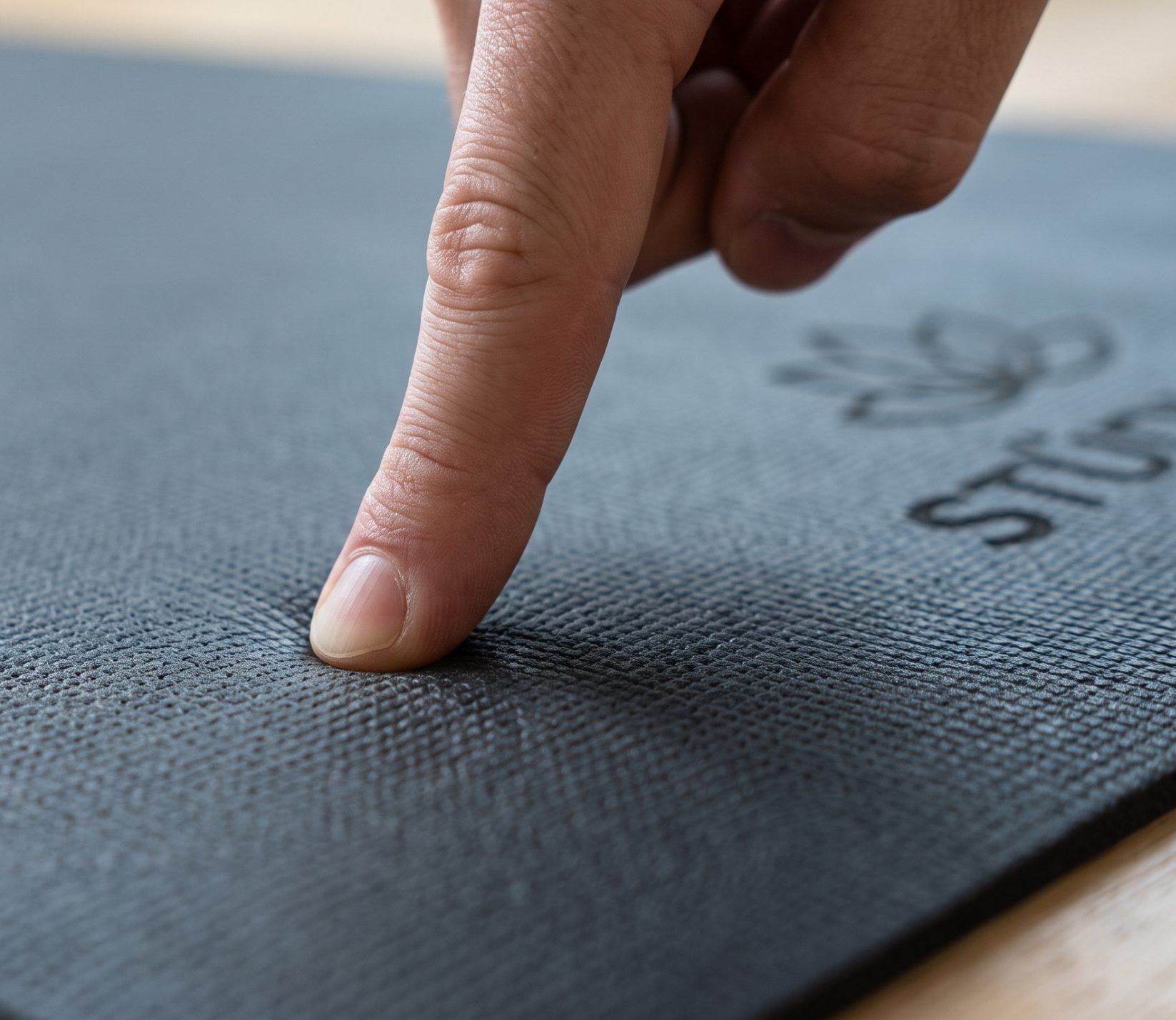
When purchasing mats in bulk for your business, you should determine the ideal mat thickness and density criteria based on the type of exercise your participants will perform:
-
Yoga Mats (3 mm – 5 mm):
Feeling the floor is essential for balance postures. For this reason, the ideal thickness for wholesale yoga mat orders is 4 mm and 5 mm. In our yoga mat manufacturing process, we prioritize non-slip traction and surface texture quality. For 4 mm mat production, you can choose our polyurethane (PU) yoga mats; for 5 mm mat production, our natural rubber yoga mats are the ideal choice. -
Pilates Mats (6 mm – 12 mm):
Cushioning is essential to relieve pressure on the spine and joints. For pilates studios, high-density thick mats should always be preferred. In our pilates mat manufacturing, we prioritize both cushioning comfort and long-term durability.Ideal Mat Thickness and Density Criteria in Yoga Mat Manufacturing
-
Rebound Recovery Rate:
Once localized pressure is released, the mat must regain its original shape within seconds. A high-quality mat should exhibit no roll-memory effect and must lie completely flat on the floor immediately after being unrolled from storage. -
High-Density Cellular Structure:
A compressed raw material standard that prevents hands and knees from bottoming out against the floor during workouts. Thanks to our proprietary formulation developed in-house, we manufacture mats with superior cushioning capacity. - Rubber Mat Formulation:
The raw material composition of a rubber mat is just as crucial as its thickness. The precise ratio of EPDM, EVA, and natural rubber directly determines the mat's overall quality and performance. A mat's ideal thickness varies depending on the raw material formulation engineered during production. With Simy Collection, you can manufacture custom solutions tailored to your exact quality standards.
EPDM and Natural Rubber (NR): Rubber derivatives are the highest-density materials in the mat industry. They adhere firmly to the floor, eliminate slippage, and deliver exceptional spinal support even in ultra-thin profiles. Due to their inherent weight and dense molecular resistance, rubber mats are typically manufactured in thicknesses of 3 mm to 5 mm.
XPE and IXPE (Cross-Linked Polyethylene Foam): Thanks to its micro-cellular structure, this material retains its integrity under high pressure. Chemically or physically cross-linked polymers prevent sweat and moisture absorption entirely. An XPE mat within the 6 mm to 8 mm range delivers far superior shock absorption and rapid rebound recovery compared to standard 12 mm mats. EVA (Ethylene Vinyl Acetate): It features an open-pore structure with low rebound memory. Because the cells compress rapidly under body weight, it must be manufactured at a minimum thickness of 10 mm to 15 mm to provide adequate joint protection.
-
Pro Tip: Thickness alone is not an indicator of quality. If a mat’s density is low, it will easily bottom out against the floor under pressure. The ideal thickness required for any mat depends directly on its raw material formulation.
Contact our sales team for wholesale mat manufacturing and order details.